Benzene (C6) was my desperation and my breakthrough -
The story behind the symbol of my Complexity Compass
For many years, a hexagon (or ring) made up of six C’s has been a powerful and meaningful symbol for me. It is my Complexity Compass.
In physics and chemistry, a ring or hexagon of six C’s represents an arrangement of six carbon atoms. It may be the ring structure of a benzene molecule (C₆H₆) or the fundamental building block of the nanomaterial graphene. Ever since my own research in this field, both benzene and graphene have become deeply symbolic materials for me.
So, if you do not mind reading a little physics, I invite you to take a moment and explore this part of my story.
Benzene
The benzene molecule was the source of my deepest frustration during my PhD - and ultimately led to the moment of insight that rekindled my joy in research and shaped the direction of the rest of my dissertation.
In 2009, I conducted experiments to understand how small organic ring molecules form bonds with crystal surfaces. Molecules belong to the world of chemistry, while crystals belong to the world of physics. My work was therefore about understanding how these two worlds, physics and chemistry, connect and communicate with one another.
I had already carried out a series of experiments with other molecules and had found a way to understand how they formed bonds with the surface. Repeating these experiments with benzene was supposed to be little more than the final piece of the puzzle, the last step in confirming the understanding I had developed of the interaction between molecules and crystal surfaces. It was meant to confirm what I already believed I knew.
Instead, everything went wrong.
When I performed the experiment, all my measurements indicated that virtually nothing happened at the surface. In every previous experiment, the arrival of the molecules had produced a clear response from the crystal surface. With benzene, however, nothing happened. Against all expectations, the surface remained completely unchanged.
I was shocked.
At first, I assumed I had made a mistake, so I repeated the experiment. The result was exactly the same. I checked the entire experimental setup, dismantled parts of the apparatus, rebuilt them, and tested everything again. Yet the outcome never changed. The molecules had unquestionably reached the surface, but unlike with other, closely related molecules, the surface seemed to have no interest whatsoever in forming a bond with them.
How could that be?


Aromaticity - the clue to Benzene's stability
It took me some research in chemistry literature to find out that Benzene had an amazing characteristic that made it different to all the previous molecules I had experimented with. Benzene was aromatic. What was that? When Benzene was first discovered chemists only knew molecules that formed chains. Benzene, however, showed some characteristics that did not make sense to the chemists. After many years of puzzling research, August Kekulé finally had a daydream that prompted him to hypothesize that Benzene was actually a ring-shaped molecule. This ring-shaped nature of Benzene was later proven and turned out to revolutionalize the entire understanding of molecular chemistry.
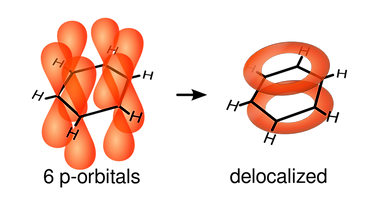
In the Benzene molecule, this ring nature leads to a very specific effect. The carbon atoms in the molecule share their bonding electrons not only with their neighboring atoms as it would be usually the case. In Benzene, these bonding electrons are shared with the entire molecule! All carbon atoms donate their bonding electrons to a delocalized electron ring that expands across the entire molecule. This has enormous consequences: Because all atoms in the molecule share all their electrons, the molecule as a whole becomes much more stable than all other ring molecules that do not have this kind of shared bonds. In fact, this phenomenon was so special that it received its own name: Such molecules are called aromatic.
In my experiments this meant that Benzene was so stable and had such strong bonds that it did not react strongly with the crystal surface. That is why I did not see it in my measurements that mainly observed the reaction of the surface. Benzene prefered to stay in its ring structure while all other non-aromatic ring molecules had changed their structure and reacted intensely with the crystal.
From now on I was systematically examining the role of aromaticity for the reaction with the surface and this shaped my entire further PhD work...
Maybe you can already anticipate why this phenomenon became such a meaningful symbol for me:
Molecules that donate their electrons to a ring that is shared by all atoms in the molecule are much more stable than molecules that do not do this. The shared ring gives Benzene its stability, its power. And: This ring structure was discovered in a dream and changed chemistry forever. It was discovered not only by the rational mind but from the contribution of the creative intuitional mind. This is why the C6-hexagon has such profound meaning to me.

View of our measuring equipment at the Berlin electron storage ring and synchrotron BESSY II in Adlershof

Graphene
The nanomaterial graphene (and its silicon-based brother silicene) follow a similar principle and are perhaps even more fascinating than benzene.
Graphene is a two-dimensional layer of hexagonally arranged carbon atoms. In a way, it's a larger version of benzene. Instead of a single C6 ring or hexagon (benzene), it's an "infinite" chain of such carbon hexagons. Because of this hexagonal structure, graphene does something extraordinary, similar to benzene: the carbon atoms in graphene donate their bonding electrons to a layer that extends across the entire graphene sheet. This means that the electrons are no longer localized anywhere, but rather spread out across the entire sheet like water. As a consequence, graphene is incredibly strong. Imagine: although a graphene sheet is only a single atom thick, it's so strong that you could carry a cat with it without the material tearing. In fact, graphene is the strongest material known to date, about 200 times stronger than steel.
Graphene was discovered in 2004 by Andre Geim and Konstantin Novoselov, who received the Nobel Prize in Physics for it just a few years later in 2010.
This is what makes it significant for my work today:
-
I have come to understand the power inherent in circular and hexagonal structures. From benzene, I can learn how stability can arise when individuals contribute their resources to a common goal . They share a bonding structure with each other.
-
My understanding of organizational formation is based on the linking of circles that share specific patterns and understandings of relationships. Graphene can teach us the enormous stability and effective communication that arise when the elements of a system follow common principles of connection and relationship patterns.
-
Furthermore, my conviction has been confirmed as to how important it is to integrate the intuitive mind into processes of understanding. Rational analysis may bring us clarity about our knowledge. However, deeper insights often only arise when we move beyond conceptual understanding and open ourselves to intuitive approaches to complexity, be it through feeling, dreaming, or play.
The intuitive mind is a sacred gift.
and the rational mind its faithful servant.
We have created a society,
who worships the servant and
forgot the gift.
(Albert Einstein)